|
|
|
|
|
||
American Society of Polar Philatelists
Presents
A monthly reprint of the longest-running feature column in the Ice Cap News
( Back Up Tidbits )
| B.U.T. is intended to provide snippets of additional information or extracts of pertinent, existing facts about expeditions and their postal history that may cause us to muse or be amused by some unusual element of polar history philately. |
From the Ice Cap News, Vol. 33, No. 5 (Sep-Oct 1988)
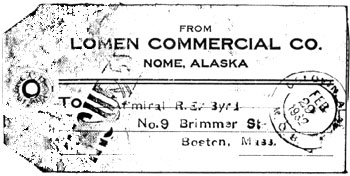
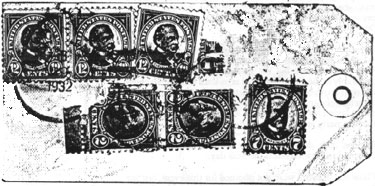
This (Figures 1 & 1a) appears to be a piece of Depression-era Alaskan postal history. And it is. The mailing label bears two Golovin post office strikes. Both the "M.O.B." on its face (Figure 1) and the single ring cancel killing the $1.47+ postage on its reverse (Figure 1a) are canceled 29 February 1932, B U T -- though seemingly rather ordinary, what's on this label is a bit extraordinary. First, the barely legible, single ring cancel from one of the latter Gold Rush-era post offices, figure 1 clearly shows no slugs along its lower rim. Somewhat smallish lettering extends about halfway around the upper part of the dial. Since only one first class postmarker from this office had "Golovin, Alaska" in a shorter than normal typeface, and that also was the only one with nothing along the lower part of its rim, it would appear that this definitely identifies it as a "Helbock" type 5.2 B U T -- 5 August 1933 was the earliest known cancellation date in a Golovin type 5. Until now. This use is 1½ years before that. B U T -- this cancellation, whether a newly discovered earliest usage or not, is not really from Golovin, Alaska. There wasn't such a place then. A federally-sponsored publication calls this small native settlement about 90 miles east of Nome on the Seward Peninsula, Golovnin, on Golovnin Bay. In 1940 there were 135 (mostly native) people living in this mining camp, "situated in the rich Golovnin Bay Mining district." Russian explorers Etolin and Vasilief named this site in 1822.3 So it's an interesting piece of Alaskan postal history. B U T -- that's not all. This piece also is polar postal history. And that's not only because it's from the sub-Arctic. It's because it's actually related to a polar expedition that never should have gotten to Golovin. And didn't. It was an Antarctic expedition. Golovin had mining, two herring salteries and several stores. It also had a small reindeer industry including a cold storage plant. Some of the reindeer herders and businessmen were natives. Two weren't. Carl Lomen had come to Alaska in 1900 with his lawyer father. The father had intended simply to spend the summer away from his stateside practice. He stayed to become a federal judge in Nome. Carl and his brothers went into the reindeer business.4 Over the years they had sales offices in Washington, D.C., Seattle, Washington and various New York City addresses.5 But the heart of the Lomen Reindeer Corporation was in and around Nome, Alaska.6 There they had their herds tended, processed the beef for shipping south and directed native tailors who fashioned parkas, trousers, mukluks, mittens and other garments and accessories from reindeer skin and other animal hides. They developed a reputation as expedition outfitters and were sought for their expertise in cold weather survival. Richard Byrd was introduced to Carl Lomen in May 1925 when preparing for his Navy aviation unit's participation in the MacMillan Arctic Expedition to Greenland.7 He would call upon his advice and logistical support for all three of his private expeditions.8 Lomen seems to have been contacted by Byrd to outfit his Second Antarctic Expedition shortly after return of the first. Byrd was particularly delighted with a sample flight suit he received in early 1931.9 Undoubtedly, this was in response to his planning for "Byrd II." Although Byrd remained close to the Lomens (especially Carl) into the 1950's, there was a difficult period during the planning of "Byrd II" that caused some disturbance to their friendship. It was a financially difficult time for many. Byrd apparently was succumbing to the economic pressures of trying to staff and supply an expedition during the depth of the Depression when he complained to Carl Lomen about the bill he'd just received for a recent order of expedition furs. He's shocked by the $9,615 figure and implies that his logistical arrangement with the Lomens apparently has gotten out of hand. He mentions having written to him, and his brother (Ralph) on 20, 26 and 28 February 1932, asking that further shipments be delayed until an accounting could be made. He also seems to express some anguish at having shipments sent by air. He suggests that only samples be so sent, with normal shipments waiting for July when they can be dispatched at less cost by boat.10 Byrd has just returned from a long lecture trip and apparently discovered that his instructions had not been heeded. The dates in his 14 April 1932 letter seem to indicate that he's displeased by something that had been sent around the end of February. It would appear that this mail label might have accompanied that particularly annoying shipment from the Lomens in Alaska. It's dated 29 February 1932 and, though missing some of its stamps, appears to have been franked with at least several dollars worth of postage. That would have been a rather high postal charge in those days. Perhaps this indicates that it contained more furs than Byrd was prepared to receive or that it was dispatched by an expensive means of transit (although air mail is not indicated on the label). The face of the label (with Byrd's familiar "9 Brimmer St." Boston address) is diagonally stamped "INSURED" on its left side, suggesting that the contents had value (furs?). It was mailed (29 February 1932) one day after the last of the three letters Byrd mentions. No doubt the Lomens hadn't time to receive and digest Byrd's three February letters before mailing the shipment that bore this label. After receiving the trio of letters, however, it is unlikely that they would have sent anything more until hearing further from Byrd. Since it might be reasonably assumed that shipment of hand-tailored expensive furs from the Lomens to Byrd did not occur frequently, we might conjecture that the discomforting shipment, to which Byrd makes reference, indeed was sent under this label. Byrd is still trying to settle his Lomens' bill after the expedition returns. He sends his friend Carl $1,000 on account, but confides that he still has $60,000 due other second Antarctic expedition creditors.11 So, this label is directly associated with the Second Byrd Antarctic Expedition, B U T -- not the one with which history is most familiar. At the time of its use, the Second Byrd Antarctic Expedition was due to depart in the fall of 1932. Even the aforementioned 14 April 1932 letter seems to still harbor this hope. Byrd says that surface-mailing packages from Alaska in July still would allow enough time for their receipt (presumably for a fall, 1932, departure). It wouldn't be until later that Byrd would realize that he hadn't collected enough donations to pay for a 1932 expedition.12 He'd have a Second Antarctic Expedition, but it would be the 1933-35 one -- not the aborted one planned for 1932-34.
We are grateful to George Hall who greatly assisted the author in gaining access to the Lomen Collection at the University of Alaska. Acknowledgments also are extended to Alison Wilson, National Archives, and Renee Blahuta, Elmer E. Rasmuson Library, U. of Alaska, for their research assistance. END NOTES
1 P.H. Anderson was appointed Golovin's first postmaster on 5 May 1899 (Melvin B. Ricks, Directory of Alaska's Postmasters and Postoffices 1867-1963 [Ketchikan, AK: Tongass Publishing Co., 1965], 23). However, it wasn't until 1901 that the office's establishment first appeared in the Postal Guide (Joseph J. Cavagnol, Postmarked Alaska [Holton, KS: The Gossip Printery, 1957], 83). That's also the earliest year to be seen in its first cancellation (Richard W. Helbock, Postmarks of Territorial Alaska, 3rd ed., rev. [Lake Oswego, OR: La Posta Publications, 1986], 84). There was a two-year closure (1906-08) before it reopened for a half-century of service that ended on 30 September 1958. 2 Helbock, 84. 3 Merle Colby, A Guide To Alaska (New York: MacMillan Co., 1939), 363. This was written and published under the Federal Writers' Project of the Works Progress Administration. Alaska Governor John W. Troy wrote the foreword and "sponsored" the book. 4 Dorothy M. Brown, Mable Walker Willebrandt; Private Practice, Public Life (Knoxville: U. of Tennessee Press, 1984), 211. 5 Lomen Collection (Box 8, Folder 150), U. of Alaska Archives, Elmer E. Rasmuson Library, Fairbanks, AK. Addresses taken from various letters and other documents. 6 Lomen's company is referred to in Lomen Collection documents as "Lomen Reindeer Corporation." However, since the Lomen enterprise was involved with more than Reindeer, it would seem logical that they may have utilized shipping tags other than those addressed as the "Lomen Reindeer Corporation." This might explain the "Lomen Commercial Co." on this label. 7 Lomen Collection, 1953 typescript of a "Foreword" written by Byrd for an unknown book manuscript written by Carl Lomen. 8 Lomen Collection, numerous letters from 23 January 1926 to 24 May 1935 contain orders and requests for advice needed by the North Pole flight expedition, "Byrd I" and "Byrd II." Though documents extend beyond this period, there appears to be no further mention of Lomens as polar expedition outfitters. This could be the result of the Interior Department's successful buy out of "whites" in Alaska's reindeer industry. Lomen had been a particular subject of the Department's impropriety investigations for about a decade before finally settling with the government around 1939 to make Alaska's reindeer the "sole preserve of the Eskimo" (Brown, 212). 9 Byrd letter to Lomen, 6 May 1931, Lomen Collection. 10 Byrd letter to Lomen, 14 April 1932, Lomen Collection. 11 Byrd letters to Lomen, 22 and 24 May 1932, Lomen Collection. 12 Kenneth J. Bertrand, Americans in Antarctica, 1775-1948 (New York: American Geographical Society, 1971), 314.
Back to the ASPP Home Page | Back to the South-Pole Home Page | Next Page
|